October 2026
Greenwashing in a changing sustainability landscape
Greenwashing has evolved. While scrutiny once focused on broad environmental claims, regulators, investors, NGOs, and journalists are increasingly examining the credibility of energy transition strategies. Net-zero commitments, transition finance products, renewable energy investments, and climate leadership claims are now at the center of many greenwashing allegations.
This scrutiny is reflected in the wider business conduct risk landscape. A 2026 survey of C-suite executives found that the energy transition (#2) and greenwashing (#4) are among the top material risks companies expect to navigate over the next three years.
# Top material risks according to C-suite executives over the next 3 years
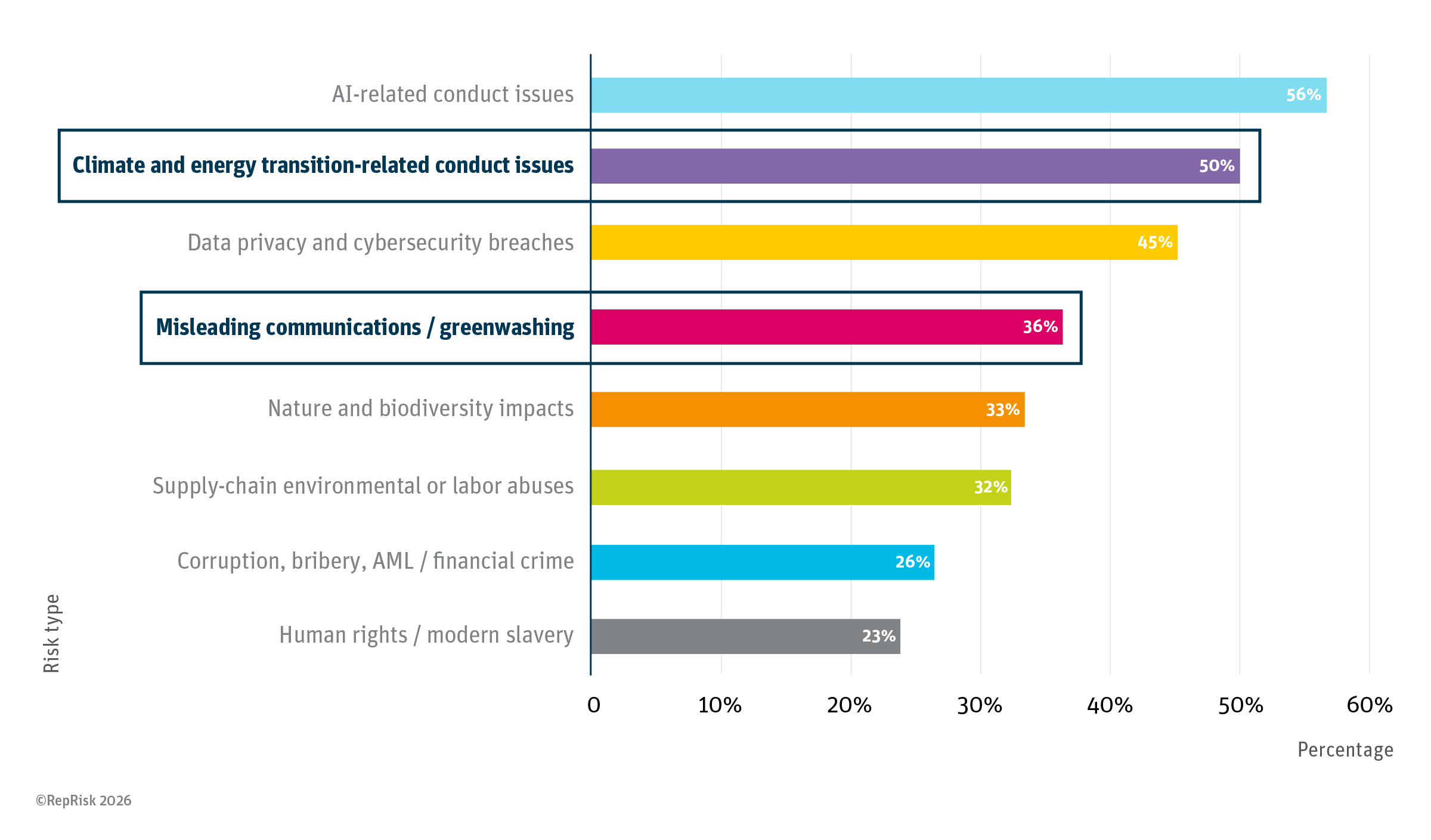
Question: Which of the following business conduct risks were / will be the most material for your company in each of the following time periods? Rank top 3. Source: Oxford Economics survey, January 2026.
RepRisk data reflects the growing scale of that scrutiny: greenwashing risk incidents increased 112% between 2022 and 2026, while 1,594 companies were linked to greenwashing in 2026, up 28% from the previous year.
This evolution has given rise to what is often described as transition-washing: the tendency to emphasize future climate ambitions, long-term transition plans, or selective low-carbon investments without demonstrating corresponding changes in present-day business activities.
# Why transition-washing matters
Historically1, greenwashing often involved vague or unsubstantiated environmental claims. Today, many of the most scrutinized claims relate to the energy transition, including net-zero targets, transition finance, renewable energy investments, carbon capture technologies, sustainable aviation fuels, and other decarbonization initiatives.
In 2026, ecosystems and biodiversity became the environmental issue most frequently linked to greenwashing risk in RepRisk data, overtaking climate change and emissions for the first time in five years. The finding underlines why credible transition strategies increasingly need to account for the wider environmental footprint of the activities they support.
As organizations compete to demonstrate climate leadership, the risk increasingly lies in the gap between stated ambitions and real-world performance. Greenwashing therefore often arises not through outright falsehoods, but through selective disclosure, optimistic framing, or incomplete representation of environmental and social impacts.
# How are regulators responding to greenwashing?
Regulators around the world are introducing new disclosure rules, claim substantiation requirements, and sustainability reporting frameworks designed to reduce misleading environmental claims. While the details vary by jurisdiction, most initiatives share a common objective: increasing transparency and accountability around sustainability-related communications.
# Notable regulations and frameworks addressing greenwashing
Global
- At the international level, standard setters and multilateral organizations are reinforcing expectations for credible transition reporting. The International Sustainability Standards Board (ISSB) has introduced IFRS S1 and IFRS S2 to establish globally consistent sustainability and climate-related disclosure standards.
- The Taskforce on Nature-related Financial Disclosures (TNFD) expands disclosure expectations beyond climate to include nature-related risks and dependencies, recognizing that credible sustainability strategies must address biodiversity and ecosystem impacts alongside carbon emissions.
- The Organisation for Economic Co-operation and Development (OECD) has highlighted growing concerns around false, misleading, or unsubstantiated environmental claims. In its policy paper, Protecting and Empowering Consumers in the Green Transition, the OECD examines greenwashing practices and policy responses, including measures to improve the substantiation and clarity of environmental claims, strengthen consumer protection, and support effective enforcement.
- Similarly, the OECD Guidelines for Multinational Enterprises on Responsible Business Conduct (OECD MNE Guidelines) reinforce expectations that companies communicate sustainability information transparently and undertake due diligence to identify, prevent, mitigate, and account for adverse environmental and human rights impacts throughout their operations and value chains.
Europe
- The European Securities and Markets Authority (ESMA)’s Fund Name Guidelines set criteria for funds using ESG or sustainability-related terms to reduce greenwashing risks in investment products.
- The Corporate Sustainability Reporting Directive (CSRD) and theEuropean Sustainability Reporting Standards (ESRS) require in-scope companies to disclose standardized sustainability information, including information on climate transition plans, targets, governance, and material environmental impacts.
- The EU Taxonomy Regulation establishes science-based criteria for determining whether economic activities can be considered environmentally sustainable, reducing the risk of inconsistent or misleading sustainability classifications.
- The Empowering Consumers for the Green Transition Directive (EmpCo) strengthens consumer protection by prohibiting vague environmental claims, misleading sustainability labels, and unsupported assertions regarding climate neutrality.
- Meanwhile, the Corporate Sustainability Due Diligence Directive (CSDDD) expands expectations beyond disclosure by requiring in-scope companies to identify and address adverse human rights and environmental impacts across their own operations, those of their subsidiaries, and the activities of business partners in their chains of activities.
- The UK Financial Conduct Authority (FCA)’s Anti-Greenwashing Rule requires sustainability-related claims about financial products and services by FCA-authorized firms to be fair, clear, and not misleading, while the Competition and Markets Authority (CMA)’s Green Claims Code requires consumer environmental claims to be truthful, clear, and substantiated, including across supply chains.
- The Swiss Ordinance on Climate Disclosures requires in-scope companies to report on climate-related risks, impacts, and transition plans, while the Swiss Financial Market Supervisory Authority (FINMA)’s Greenwashing Guidance emphasizes transparency and appropriate governance and controls for sustainability-related investment products.
North America
- In the US, regulatory developments continue to evolve amid legal and political uncertainty. The Federal Trade Commission’s Green Guides provide guidance on environmental marketing claims and are undergoing regulatory review. At the state level, California’s Climate Corporate Data Accountability Act (SB 253) and Climate-Related Financial Risk Act (SB 261) establish climate disclosure requirements for large companies doing business in California.
- Canada has published guidance through the Canadian Securities Administrators (CSA)to improve ESG-related investment fund disclosures and reduce misleading sustainability claims, while the Canadian Sustainability Standards Board (CSSB) has adopted Canadian Sustainability Disclosure Standards based on IFRS S1 and S2.
Asia Pacific (APAC)
- The Monetary Authority of Singapore (MAS) has issued Environmental Risk Management Guidelines for banks, insurers, and asset managers, alongside broader moves toward ISSB-aligned sustainability reporting.
- The Australian Securities and Investments Commission (ASIC) has taken an increasingly active enforcement approach, pursuing companies and investment managers over misleading sustainability claims.
- Japan has strengthened its sustainability disclosure framework through the phased introduction of mandatory Sustainability Standards Board of Japan (SSBJ) reporting requirements, which are closely aligned with the ISSB standards.
- South Korea has strengthened its sustainable finance framework through the Korean Green Taxonomy (K-Taxonomy) and green bond guidelines, while moving toward phased mandatory sustainability disclosures aligned with ISSB standards.
- China continues strengthening its green finance framework through its green taxonomy, green bond standards, and mandatory sustainability reporting requirements for certain listed companies, strengthening the consistency and transparency of sustainability disclosures.
- In Hong Kong, the Securities and Futures Commission (SFC) requires authorized ESG funds to substantiate their ESG focus through enhanced disclosures and periodic assessments.
Middle East
- The UAE has strengthened its sustainable finance framework through initiatives including the UAE Sustainable Finance Framework and principles on climate-related financial risk management and sustainability-related disclosures. These measures support greater transparency and climate risk management across the financial sector, in line with the UAE’s Net Zero 2050 Strategy.
# What this means for risk, compliance, and sustainability managers
Increasingly, organizations need to understand whether sustainability or climate commitments are supported by evidence, implementation, and observable progress. Transition-related risks can emerge from changing stakeholder expectations, media scrutiny, NGO campaigns, litigation, regulatory developments, and allegations of greenwashing or transition-washing. As scrutiny around the energy transition continues to evolve, organizations need visibility into how their claims, strategies, investments, and business activities are perceived by external stakeholders.
RepRisk provides an outside-in perspective on business conduct risk, helping clients identify emerging issues related to climate commitments, transition plans, transition finance, environmental impacts, human rights concerns, regulatory compliance, and allegations of greenwashing or transition-washing. This can help organizations assess the credibility of transition strategies and complement traditional climate and financial risk assessments.
Want to learn more about how RepRisk solutions mitigate greenwashing risk?
Request a demo and a RepRisk specialist will contact you.
Copyright 2026 RepRisk AG. All rights reserved. RepRisk AG owns all intellectual property rights to this report. This information herein is given in summary form and RepRisk AG and/or the third party contributors to this report make no representation or warranty that any data or information supplied to or by it or them is complete or free from errors, omissions, or defects. Without limiting the foregoing, in no event shall RepRisk AG and/or the third party contributors to this report have any liability (whether in negligence or otherwise) to any person in connection with the information contained herein. Any reference to or distribution of this report must include a link to the content to provide sufficient context. The information provided in this presentation does not constitute an offer or quote for our services or a recommendation regarding any investment or other business decision, and is not intended to constitute or to be used as a substitute for legal, tax, accounting, or other professional advice. Please note that the information may have become outdated since its publication. Should you wish to obtain a quote for our services, please contact us.
Decision‑grade means suitable for identifying and prioritizing risk exposure as an input into a broader decision‑making process. RepRisk data does not determine legality, compliance, thresholds, or required actions, and does not prescribe investment, procurement, or engagement decisions.